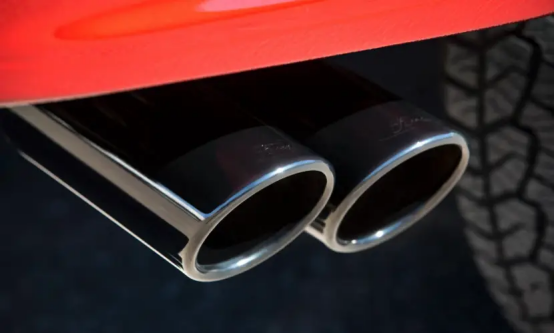
In the world of car modification and performance discussions, exhaust system design has always been a controversial and mysterious topic. Among them, the debate over single-sided exhaust vs. double-sided exhaust is particularly fierce. These two designs not only present completely different styles visually, but also have their own fans in terms of performance and sound characteristics. This article will explore the differences between these two exhaust layouts in depth, revealing the engineering principles and “metaphysical” elements behind them .

- Appearance and design
Single-sided exhaust is often seen as a more traditional and purer design choice. Many classic performance cars such as the early Porsche 911 and Honda S2000 use a single-sided exhaust layout. This design gives people a “function first” visual feeling, suggesting that the performance of the vehicle does not need to be proven by an exaggerated appearance. In contrast, double-sided exhaust is more visually impactful and can balance the visual effect of the rear of the car, especially for wide-body models. Modern high-performance cars such as the BMW M series and Mercedes-Benz AMG almost all use a double-sided exhaust design, which has become part of the high-performance visual language.

- Performance
From a purely engineering perspective, the design of an exhaust system is far more complex than simply “one-sided or two-sided”. The key lies in the optimization of exhaust back pressure and airflow path.

Dual exhaust
It can provide a larger total exhaust cross-sectional area, reduce back pressure at high speeds , allow the design of a more direct exhaust path , and may help reduce exhaust temperature on turbocharged models . In reality, many dual exhaust systems are only “visual dual exhaust” . In fact, they still share the same muffler or catalytic converter, and the performance advantage is limited. A true performance dual exhaust requires a completely independent piping system, which significantly increases cost, weight and chassis layout difficulty.

Single side exhaust
A simpler layout is usually lighter , takes up less chassis space , is less expensive to maintain , and may result in more desirable exhaust pulse harmonics in certain layouts .

- advantage
Single side exhaust
Producing a more focused, purer sound. As the exhaust pulses from all cylinders converge to one outlet, the interaction of the sound waves produces unique harmonics. This is why the single-sided exhaust sound of many classic sports cars is so memorable.
Dual exhaust
Produces a more complex acoustic characteristic. When the exhaust pulses are distributed to both sides, a stereo effect is produced. For a V-type engine, the exhaust from the cylinders on both sides is directed to the exhaust pipe on the corresponding side, which can create a highly recognizable “dialogue” sound.
- The myth of the aftermarket
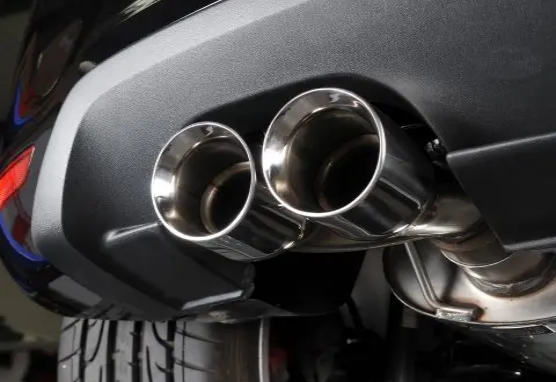
In the field of modification, dual exhaust is often regarded as an “upgrade”, while single exhaust is considered “basic configuration”. This perception has led to many modification misunderstandings . Many car owners modify dual exhaust for visual symmetry, but ignore the exhaust flow optimization designed by the original factory. A true performance dual exhaust requires double pipes, mufflers and suspension points, which may add 10-15kg of unnecessary weight . Improper dual exhaust modification may cause exhaust pulse disorder and produce discordant sound waves.